Your model and application
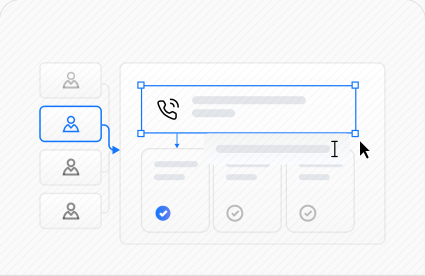
Bring the model, prompts, knowledge and business rules you intend to use. Your team controls their changes and decides which information the application may return to a customer.
AI Calling PaaS
Connect TeleAI speech and runtime capabilities with your own models and business logic. We work with your technical team on integration scope, conversation testing, diagnostics, and rollout requirements—while application decisions remain yours.
 YOUR APPLICATION, CONNECTED
AI Calling PaaS connects TeleAI voice capabilities to the application your team controls. Start with the customer interaction you want to support, then map the application, call lifecycle and operating requirements before choosing an integration approach. Our technical team participates in setup, joint testing and launch validation.
Bring the model, prompts, knowledge and business rules you intend to use. Your team controls their changes and decides which information the application may return to a customer.
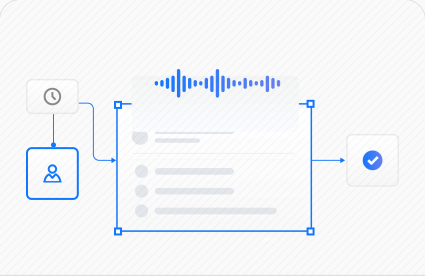
Identify the target languages, number resources, SIP requirements and expected call traffic. Together we map the required voice layers and validate the connection in your deployment environment.
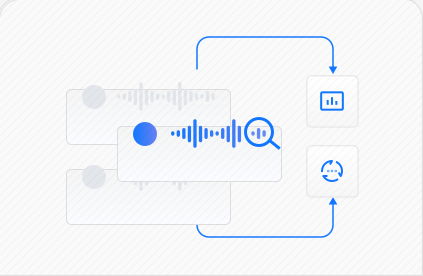
Define what tools may be called, which fields may be exchanged and how state should be handled. Technical availability does not replace the permissions and business checks required for a real action.
 THE PLATFORM STACK
Compose the voice infrastructure and runtime around the intelligence, tools, and business rules your team controls.
 Inbound calling
 Outbound calling
 SIP
SIP Call control
 Concurrency
 Number management
 ASR
ASR TTS
TTS Streaming audio
 Multi-language voices
 Custom LLM
 Conversation orchestration
 State management
 Tool calling
 Turn-taking
 Interruptions
 API
API Webhook
 Business-system actions
 Internal tools
 Call logs
 Transcripts
 Structured results
 Monitoring
 Debugging
THE APPLICATION CONNECTION
After an outbound call connects, pass the customer response to your application, apply your business logic and return the next spoken reply.
Process the response event and its responseId alongside your application context.
Apply your model, business rules, and permitted tools to prepare a response.
Send the play event with the responseId and completion flags. Handle interruptions and call completion in your application.
// Outbound follow-up: the customer requested a demo; the call is connected.
// AI opening: "Hi, I am an AI assistant calling about your demo request. Is now a good time?"
// <-- TeleAI platform -> your LLM: user speech recognized (ASR)
{
  "eventCode": "response",
  "callId": "c_8f31a2",
  "createTime": 1772084871,
  "data": { "responseId": 12, "content": "Yes, I would like a demo tomorrow afternoon.", "intent": 0 }
}

// --> your LLM -> TeleAI platform: stream the reply, spoken via TTS
{
  "eventCode": "play",
  "createTime": 1772084873,
  "data": { "responseId": 12, "content": "Thanks. I will pass your preferred time to our team to confirm.", "emotion": "calm", "completed": 1, "endCall": 0 }
}
Illustrative exchange after an outbound call connects, not a call-creation API request. The AI follows up on a demo request and records a preferred time for the team to confirm. See the documentation for the complete protocol.
TEST THE WHOLE CONNECTION
Use representative outbound interactions to test the contract between TeleAI and your application. These are validation scenarios, not new API definitions; the protocol example remains the implementation reference.
An outbound follow-up connects. The customer asks to continue the conversation later rather than discuss the offer now.
Could you call after six?
Trace the recognized speech into your application, inspect the reply returned for playback and verify how the callback preference is represented in the agreed state. Confirm that the call ends cleanly and the application receives the expected events.
An agreed field mapping and a tested event sequence. A callback preference is not a completed callback; scheduling ownership is defined separately.
The application needs an approved business lookup during a conversation, but the dependent service is slow or unavailable in the test environment.
Jointly test timeout handling, the agreed fallback response and the diagnostic information available to each team. Your application must not turn an unavailable lookup into a claim that a payment, approval or booking has succeeded.
A reproducible issue record, a named technical owner and a retest criterion. Recovery behavior and release approval stay explicit.
IMPLEMENTATION ARTIFACTS
Agree the technical deliverables and acceptance conditions before rollout. AI Calling PaaS supports implementation collaboration; a fully managed customer operation is a separate service scope.
Document the connection path, agreed fields, tool permissions and responsibility boundaries so both teams work from the same contract.
Capture normal conversations, interruptions, endings and exception cases, together with expected behavior and unresolved issues.
Name the release approvers, the diagnostic evidence to share and the escalation path. Retest affected interactions when models or application logic change.
CLEAR OWNERSHIP
Separate runtime execution from business decisions so integration, testing and support have clear owners.
Operate the voice execution layer
Own application behavior and release decisions
Your application defines model behavior, tool permissions and human handoff conditions. Supported routing and execution are agreed during integration.
PRODUCTION READINESS
Evaluate the platform together with your model, application, and operating requirements.
Review destinations, number availability, inbound and outbound routing, expected traffic, and peak concurrency.
Test languages, accents, voices, interruptions, tool failures, and the full response path across ASR, LLM, network, and TTS.
Agree recording access, retention, monitoring, structured results, and debugging responsibilities.
Confirm issue ownership, escalation contacts, service terms, and the acceptance checks required for rollout.
Capacity, performance, availability, and service requirements are reviewed for your application and target markets.
CONTINUE EXPLORING
Choose the next part of your customer operation.
Yes. AI Calling PaaS is designed around connecting voice capabilities to your application. You retain control of the model, business logic and release decisions; integration details are validated together.
No. Technical integration, joint testing and issue collaboration are agreed for AI Calling PaaS. Audience operations, campaign execution and business optimization can be discussed as a separate operating scope.
No. They illustrate the speech-event contract. Your application must validate permissions, tool responses and business state before confirming any action to a customer.
Bring your intended workflow, model/application architecture, target languages, expected traffic and required system connections. We will identify the test cases and ownership needed for a practical pilot.
Share your goals, customer context, and current process. We will agree the scope, responsibilities, and measures with your team.